
Two Juneteenths: Which One Survives?

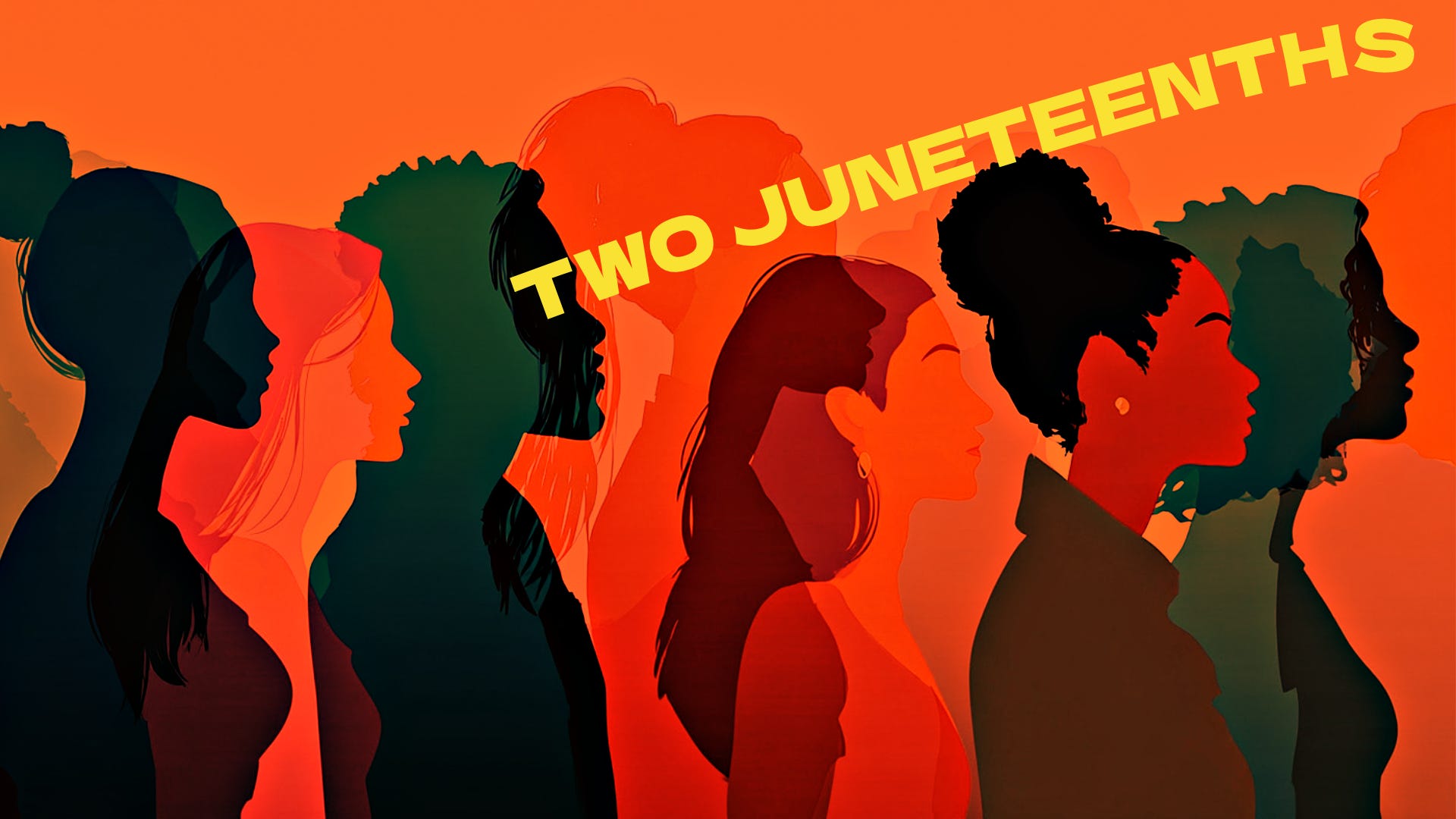
Let me be blunt: there are two versions of Juneteenth fighting for survival right now, and only one of them is telling the truth.
One version is being scrubbed, sanitized, and slowly strangled by people who believe America belongs to them by divine right. The other version is raw, documented, and inconvenient, the kind of history that makes certain people shift uncomfortably in their seats at school board meetings before voting to ban it.
The battle over Juneteenth isn't really about a holiday. It's about two completely irreconcilable answers to one foundational question: What is America, and who does it belong to?
To understand the stakes, you have to understand the worldview doing the erasing. There's a version of American identity, call it Nationality of Inheritance, that operates like a deed to property passed down through bloodlines and baptism certificates. In this framework, America is a White Christian Nation, founded by White people, for White people, consecrated by God and protected by destiny. Blood and soil. The land is theirs because their ancestors took it, built it, and, in their telling, civilized it. This isn't a fringe position whispered in dark corners; it's baked into the Originalism that treats the Constitution as a sacred text written for a specific people in a specific time, and how dare you suggest otherwise?!
Under this worldview, the country is already perfect, or was, before certain people started complaining. Black people, Indigenous people, immigrants, Latinos, Asians, anyone outside that founding ethnic-religious core, are guests at best, problems at worst. The operating logic is brutally simple: we built this, we own this, so we can do whatever we want to you. Enslave you. Remove you. Intern you. Exploit you.
And if you're still here, you should be grateful.
Grateful enough to subordinate yourself, erase your culture, swallow your history, and certainly not teach your children what actually happened to their ancestors. American exceptionalism, in this telling, is God's endorsement, a permission slip to dominate other nations, other peoples, other continents, because we are Chosen. Chosen by whom, and for what, is conveniently left vague.
That worldview cannot survive an honest Juneteenth. It cannot survive the image of enslaved people in Galveston, Texas learning, two and a half years after the Emancipation Proclamation, that they had legally been free while their enslavers kept working them anyway. That story doesn't fit the "perfect country" narrative. It doesn't fit "grateful to be here." It obliterates the mythology entirely, which is exactly why they're coming for it, banning books, gutting curricula, scrubbing the word "slavery" from standards, and replacing it with language like "involuntary relocation." They aren't confused about history. They're afraid of it.
Then there's the other America, the one that actually shows up in the historical record if you're willing to look. Progressive Nationalism doesn't pretend the Declaration of Independence was ever fully realized. It starts from the honest premise that the creed, all men are created equal, was a promissory note that America has been defaulting on since the ink dried.
But here's the thing: the American story, in this telling, is not one of failure. It's one of fighting. Every generation has produced people who looked at the gap between the promise and the reality and decided to close it.
The labor movement bled for the eight-hour workday. The suffrage movement went to jail for the vote. The civil rights movement faced fire hoses and billy clubs to dismantle legal apartheid.
Each of these movements was met with the same furious backlash from people who insisted the country was already fine and that agitators were destroying something sacred. And each time, the fighters were eventually, partially, imperfectly, vindicated. Progress, backlash. Progress, backlash. That rhythm is the American story, whether the Nationality of Inheritance crowd likes it or not.
Juneteenth belongs to that second America. It is a monument to the gap between promise and reality, and to the people who refused to accept that gap as permanent. It is not a story about America's greatness; it is a story about America's potential, bought at a cost this country has never fully paid and still refuses to fully reckon with. That's the Juneteenth they want to kill, the one that tells Black people their freedom was delayed, stolen, and still incomplete.
But here's what keeps me up at night (and what should keep you up, too): we are sitting here in the twenty-first century arguing about what Juneteenth means, and we shouldn't be surprised, because we have been arguing about what America means for 250 years. The same fight that produced the Civil War, Reconstruction, and its violent destruction, the same fight that produced Jim Crow and then the civil rights movement, the same fight playing out in school boards and state legislatures right now, it has never actually ended.
So how on Earth are we supposed to agree on what Juneteenth commemorates when we still can't agree on what this country is, who it belongs to, and whether the freedom it promises was ever meant for everyone?
The holiday isn't the battle. The holiday is just the latest battlefield.
Thank you for these words, Kwaneta.
Truth to power. This is both a beautiful tribute and a call to action, thank you for sharing it.