

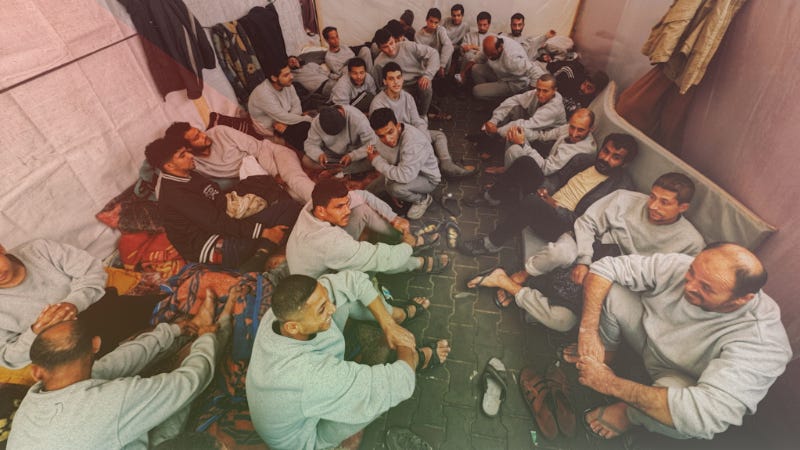
"When the decision was confirmed, all my words failed me. I was trapped inside, and all I could do was remain silent, weep, and cry for the prisoners."
– A Palestinian woman whose husband has been imprisoned for 24 years, upon learning of Israel's new Prisoners Execution Law, March 2026
I write this from a cell. My words travel through censors before they reach you, and sometimes they do not reach you at all. That alone should tell you something about who controls the narrative of incarcerated people, and why Palestinian Prisoners Day on April 17 is not a foreign cause. It is a mirror.
Palestinian Prisoners Day was established in 1974 to honor those held in Israeli prisons and to demand recognition of their rights under international law. Thousands of Palestinians, including women and children, remain imprisoned, many without formal charges under a practice called administrative detention. Since October 2023, their families have received no visits. Since that same escalation began, Israeli authorities banned lawyers from meeting with prisoners entirely. For over two and a half years, families have had no confirmed word about whether their loved ones are alive, injured, or dead. That isolation is not a side effect of imprisonment. It is the punishment itself.
I know what deliberate silence feels like. I know what it means when the system decides your family does not need to know your condition. I know what it means to be rendered legally invisible while your body is very much present and suffering. That knowledge is why I cannot be quiet about what is happening to Palestinian prisoners. Neither can you.
A new law written in death
On March 30, 2026, the Israeli government passed what is now called the New Prisoners Execution Law. The law applies exclusively to Palestinians. Any Palestinian convicted of an act resulting in the death of an Israeli citizen faces a mandatory death sentence. The conviction does not require a unanimous jury. A simple majority vote is sufficient to end a life. Once sentenced, execution by hanging must be carried out within 90 days, with almost no possibility of pardon. A new prison is already being built specifically to carry out these hangings.
Read that again. A law designed for one ethnic group. Conviction by majority, not unanimity. Death within 90 days. No pardon. A dedicated execution facility already under construction.
If you have spent any time navigating the American legal system, you already recognize the architecture of this. Non-unanimous jury convictions were used in Louisiana and Oregon for decades, disproportionately convicting Black defendants. The death penalty in the United States has never been applied equally across race or class. Legal scholars, civil rights organizations, and formerly incarcerated people have documented this for generations. Like Israel, the United States built discrimination into the procedural fabric of its justice system so that it could be denied. The target was always the same. Only the paperwork changed.
Race, class, and the carceral body
Systems-impacted people in America are not a monolith, but we share a common experience with state power: our bodies have been determined to be threats before we ever acted. Our neighborhoods were policed before we were born. Our poverty was treated as evidence of criminality. Our grief was treated as dangerous. Palestinian prisoners live under the same logic. The occupation determines them to be security threats by virtue of nationality, just as American policing has long determined Black, Brown, and Indigenous people to be suspects by virtue of appearance and address.
The parallels are not accidental. Prison systems globally share intellectual lineage. Solitary confinement, stress positions, sensory deprivation, and deliberate family separation were refined in colonial contexts before they arrived in American supermax facilities. The same logic that built Pelican Bay built the dungeons of Megiddo. We did not invent these tools. We inherited them from the same empire.
Class is the quieter thread in this tapestry, but it runs through everything. The Palestinian prisoners who languish the longest without legal representation are often from the poorest families, the families least able to mount international campaigns or retain private counsel. That is identical to the experience of the American poor who sit in pretrial detention for months or years because they cannot afford $500 bail. Money determines who waits, who dies waiting, and whose case is eventually forgotten. The New Prisoners Execution Law removes even the theoretical protection of an appeals process for those who survive on donated legal aid.
Gender and the invisible prisoner
Palestinian women are imprisoned, too. They are held in facilities where their medical needs go unmet, where menstruation is denied hygiene access, where pregnancy behind bars becomes a political statement made against their will. The erasure of incarcerated women from public discourse is a wound that American women prisoners understand intimately. We are an afterthought in the reform conversation. We are invisible in the statistics until our numbers become useful to a political argument. Palestinian women prisoners are doubly erased: first by their captivity and then by a narrative that centers male combatants while ignoring the women swept into the same detention system for political organizing, for social media posts, for living in a neighborhood deemed hostile.
When I write about being incarcerated and female in Texas, I am writing about the same structural invisibility. The bodies that carry children, that hold families together, that grieve most silently when visitation is cut, are the bodies the system most easily forgets. The wife who wept when the execution law passed, the one whose words failed her, is not an anomaly. She is the expected casualty of a system that treats prisoners as already dead and their families as acceptable collateral.
Resistance has always been cross-border
When Nelson Mandela was imprisoned on Robben Island, American anti-apartheid organizers picketed, divested, and demanded his release. Many of those organizers had themselves been surveilled, imprisoned, or harassed by American law enforcement. They understood that freedom is not divisible by geography. Their solidarity did not weaken their domestic struggle. It clarified it.
When Palestinian solidarity organizations, in response to the passage of the New Prisoners Execution Law, called a comprehensive strike across the West Bank, shutting down banks, shops, and transportation, they were using the same playbook that Black Americans used during the Montgomery Bus Boycott. Economic disruption as moral declaration. The bodies of the people are the machinery of the economy, and when those bodies stop moving, those with power are forced to look at what they have been ignoring. The international human rights organizations being called upon to intervene now are the same organizations that systems-impacted Americans call upon when domestic legal remedies fail.
We are already in relationship with each other. The question is whether we will be conscious of it.
Why your voice matters from where you stand
You may be reading this from a cell, from a halfway house, from the couch of a family member who took you in after release. You may be a mother sending money orders every month to a son you have not touched in years. You may be a lawyer who took a case pro bono and learned something about the gap between written law and lived law. Wherever you are standing, you are standing on ground that was shaped by the belief that some people are disposable.
Palestinian Prisoners Day asks you to look at that belief in its most exposed form and name it for what it is. The New Prisoners Execution Law is not an aberration. It is a logical conclusion of the dehumanization that begins long before any arrest. It is what happens when a system decides that certain lives do not require procedural protections, that their deaths can be scheduled, that their families’ grief is irrelevant.
Systems-impacted Americans did not create that logic, but we have lived under a version of it. Our credibility on this issue is not abstract. It is earned. And our silence, if we choose silence, is a gift we give to every system that has ever confined us.
What solidarity looks like from here
I cannot march. I cannot vote in this election or the next. I cannot call my congressperson from this phone without paying a corporation for the privilege. But I can write. I can tell you what I see when I read about Palestinian prisoners, and what I see is us. I see the non-unanimous verdict that ended someone’s freedom on the word of seven strangers who shared a bias. I see the visitation ban and recognize the specific cruelty of keeping love at a distance as punishment for something that love had nothing to do with. I see the 90-day execution clock and think of every incarcerated person in America who has sat on death row for a decade with no resolution, and I understand that both extremes, the endless wait and the rushed finality, are designed to destroy the human spirit.
Palestinian Prisoners Day is observed every April 17. This year it arrives weeks after a law was passed that authorizes the systematic hanging of Palestinian people based on ethnicity and a majority vote. The international human rights community is being called to respond. Organizations on the ground in the West Bank are committed to sustained protest. Families who have not heard their loved ones’ voices in two and a half years are still waiting.
We who know waiting, we who know the specific quality of silence that a prison imposes, we who have learned that no one fights for you unless you first insist that you are worth fighting for: we have something to say about this. Say it.